

Preamble: I use the word *God* throughout this essay in the way I've come to it, through the Sufi tradition- but I mean it loosely, and inclusively. If another word carries that meaning better for you, such as the universe, oneness, source, spirit, the divine, or natural wisdom- please read it that way. The essay isn't asking you to believe in a particular God, or God at all. It's asking a question about participation and perfection that holds regardless of the word you use for what's sacred to you.
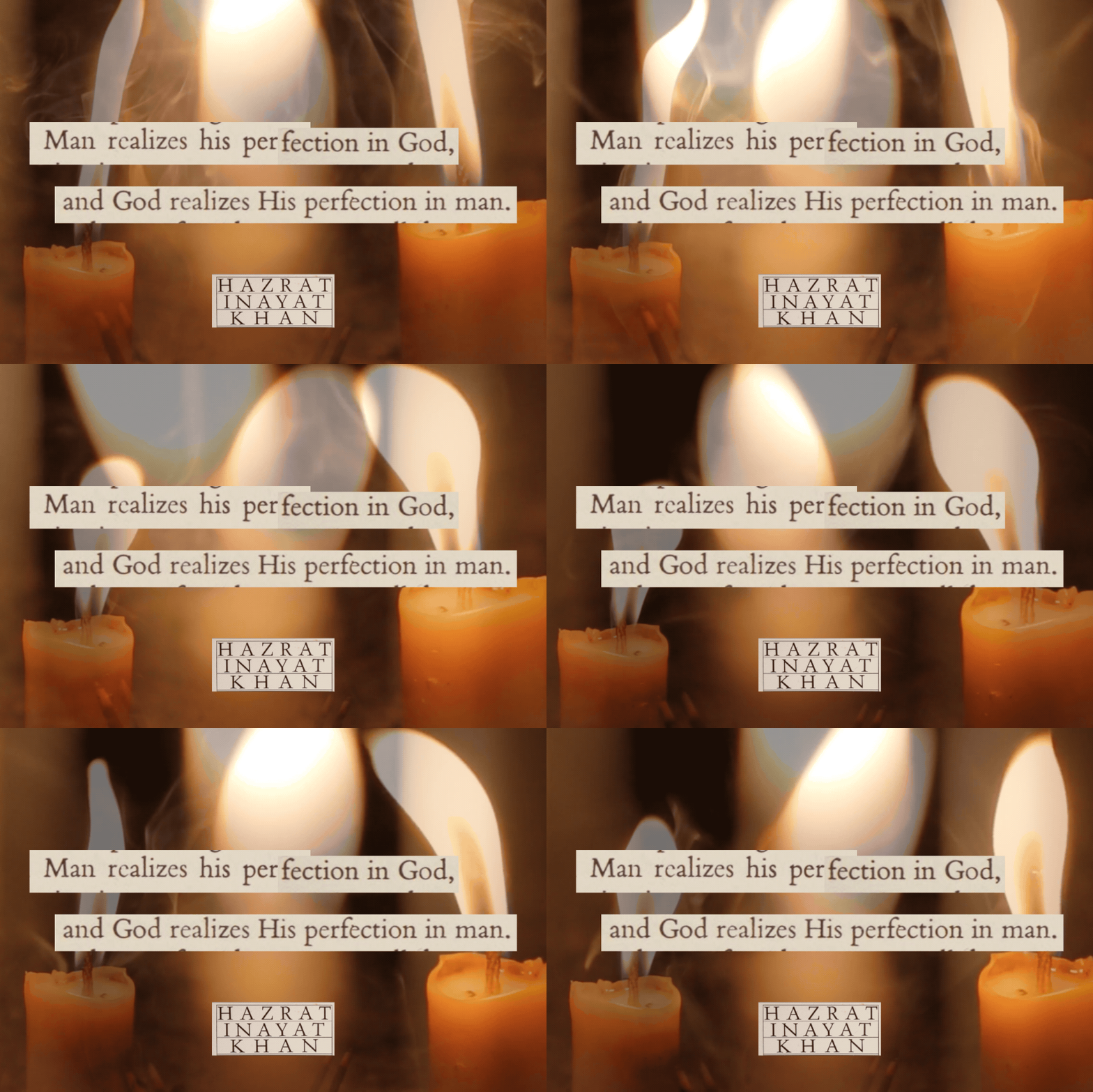
I remember when I first read this quote as part of my reading assignment earlier this year, I couldn’t make sense of it. It bewildered me. The first part I could accept; sure, this is the direction of the evolution of consciousness; we reach upward, outward, we are made complete by something larger than us to become whole again. But the latter left me perplexed, grappling without any reasonable comprehension. “God realises divine perfection in humanity”- humanity? Really?
Any attempt to aggregate the suffering, conflict, and injustices of our present time would fall short. You already know what they are- they touch all of us, in one way or another. So where exactly is the space for “divine perfection”? At times it feels as though we humans are the ones to blame for the state of things- a belief I’ve found upheld in certain environmentalist and even some spiritual circles, in their eagerness to de-centre the human. Though I notice a flaw in that framing too: an anti-anthropocentrism so absolute that it forgets our humanity as being inherent to nature.
So the quote stayed with me, unresolved. I didn’t understand how imperfection- mine, ours, the world’s- could possibly be the site of anything divine finishing itself. Unless perfection was never the finished state I assumed it to be. Unless something was still being made, and I was somehow not just witnessing that making, but caught inside of it, within its becoming.
So how could God realise divine perfection in humanity? I didn’t know yet. But I recognised the shape of the question living in me, the posture it assumed through the version of an answer I had unconsciously been living in, prior to my choosing of it.
❧
As part of my 2-year intensive in Sufi mysticism, I’ve been cultivating a deeper relationship with the elements. Initially I thought that Fire was the element I felt farthest from, the one that resonated with me the least. There was something intimidating about its nature, its capacity to burn, to hurt, to inflict pain. Proximity to Fire was uncomfortable, or so I thought.
Through my practice, I came to learn that I wasn’t actually so intimidated by Fire as I had believed. Much like a moth to a flame, I found that fire, or fire-like relationships, magnetised me. I was drawn to them without being fully aware of it. What was it about these fiery situations that drew me in?
I began noticing how much of my life I had created and attracted relationships that were fiery in nature: easily heated, volatile, passionate, grandiose, temperamental, and short-lived. These were the fires I kept walking into, as an act of nobility, as a way to prove my self-worth. There was something in me that believed that if a relationship wasn’t fiery, wasn’t challenging, wasn’t larger-than-life somehow, then it wasn’t worth it- or that I was worthless without it.
It’s been a deep process of peeling back the layers and asking myself: how many unhealthy situations have I created because of this belief? And now, how can I begin to feel worthy without relying on the ‘extraordinary’? What else can hold my sense of worthiness, without me having to prove myself by walking into fire?
When I shared this realisation with a friend, he asked if this was something I took on from my parents, and in that moment I didn’t say anything because I’m in my “I’m-done-blaming-my-parents-era”. But in reality, that was the truth- I did learn this from my parents. I now realise that I can own this truth without blaming them (-is this radical accountability?). And in this inherited experience, it becomes apparent that this imbalance isn’t mine alone to carry- it’s shared, it’s universal, a collective reckoning of sorts.
So how much of the fiery situations in our lives are ones that we are unconsciously creating for ourselves? What are the unconscious patterns we’ve inherited that we mistake for our own truth? What makes us feel worthy?
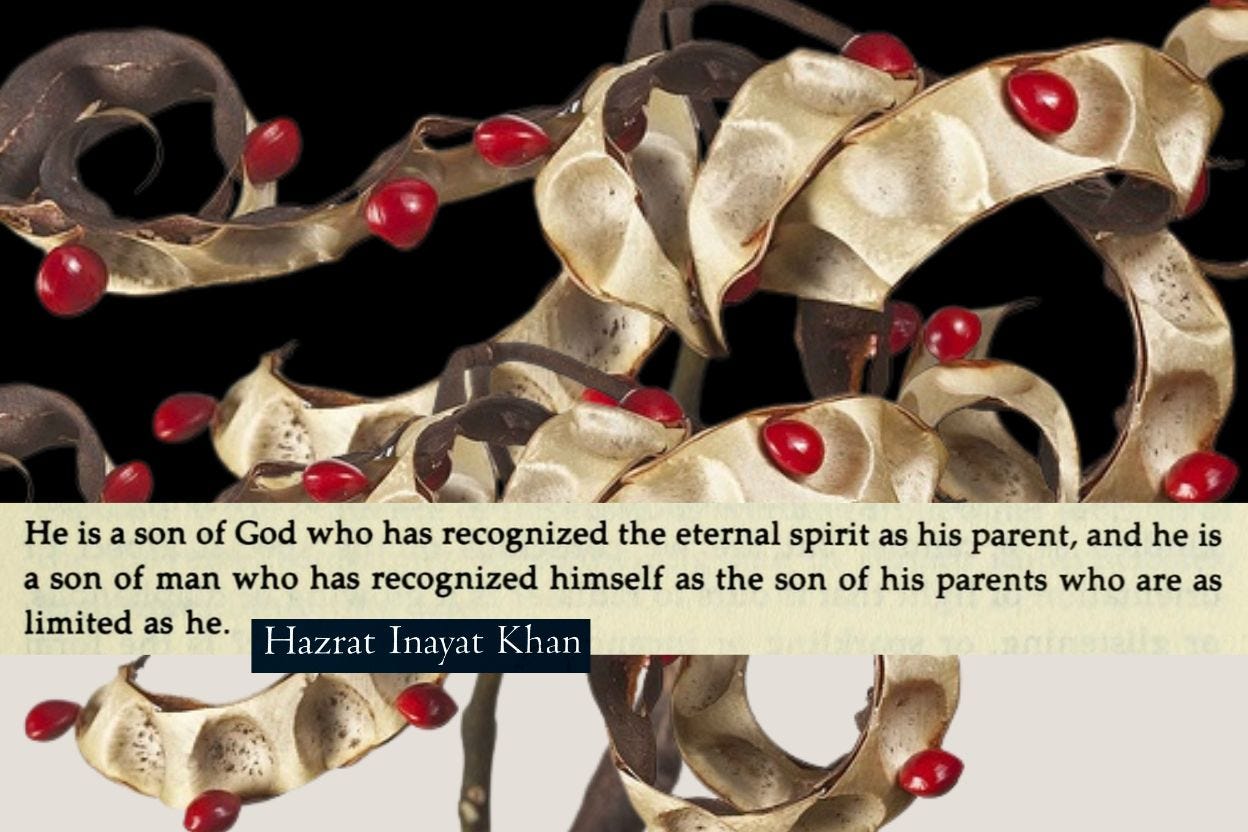
When I first read this quote, it rattled me. In only recognising my earthly parents, I had completely obscured/ denied the possibility of acknowledging my divine heritage. Which inadvertently led me to take on my parents’ limitations as my own, without any conscious choice. So now the question was, how could I recognise the eternal one as my fore-parent?
In Thinking Like the Universe, Pir Vilayat writes of this: the knowledge that we are the descendants of both our earthly parents and our Divine parents. He traces it to Christ’s words, “Be ye perfect as your Father,” and beside it, places something Hazrat Inayat Khan once said- that the ego is a false notion of what we are. Not because the personal self is unreal, but because it is partial, and when faced with difficulty, most of us try to draw our strength solely from that separate self- its smallness, its need to protect itself, its false sense of safety as familiarity. (This was the source of my unworthiness.)
There is, however, another dimension available to us, what Pir Vilayat calls the Divine Ego, the all-embracing being we touch in peak moments- in song, in meditation, in prayer, in whatever briefly quiets the smaller self enough to let the larger one through.
This is what renowned theologian Seyyed Hossein Nasr calls our “theomorphic nature”: that we carry, at once, the imprint of the divine form and the “terrestrial crust” that covers and conceals it. Both are, in his words, genuinely “parts of human nature” - not one true self hidden beneath a false one, but two inheritances, held simultaneously, with neither one cancelling the other. The mystical quest, he suggests, is not to escape the human in favour of the divine, but to want, from within the human, to transcend the merely human, without ever pretending the human isn’t real.
So the collective reckoning I sensed, without being able to name it, may be this: that what burns in one of us was never only personal, because none of us are descendants only of our earthly line. Behind the surface of our individual consciousness and memory lies the entirety of consciousness itself, which includes the mineral, plant, animal, planetary, cosmic and transcendental. Jung called the deepest layer of this the “collective unconscious.” Indeed, patterns I mistook for my own truth were inherited from my earthly parents, but out of an ignorance/ amnesia, of my Divine inheritance.
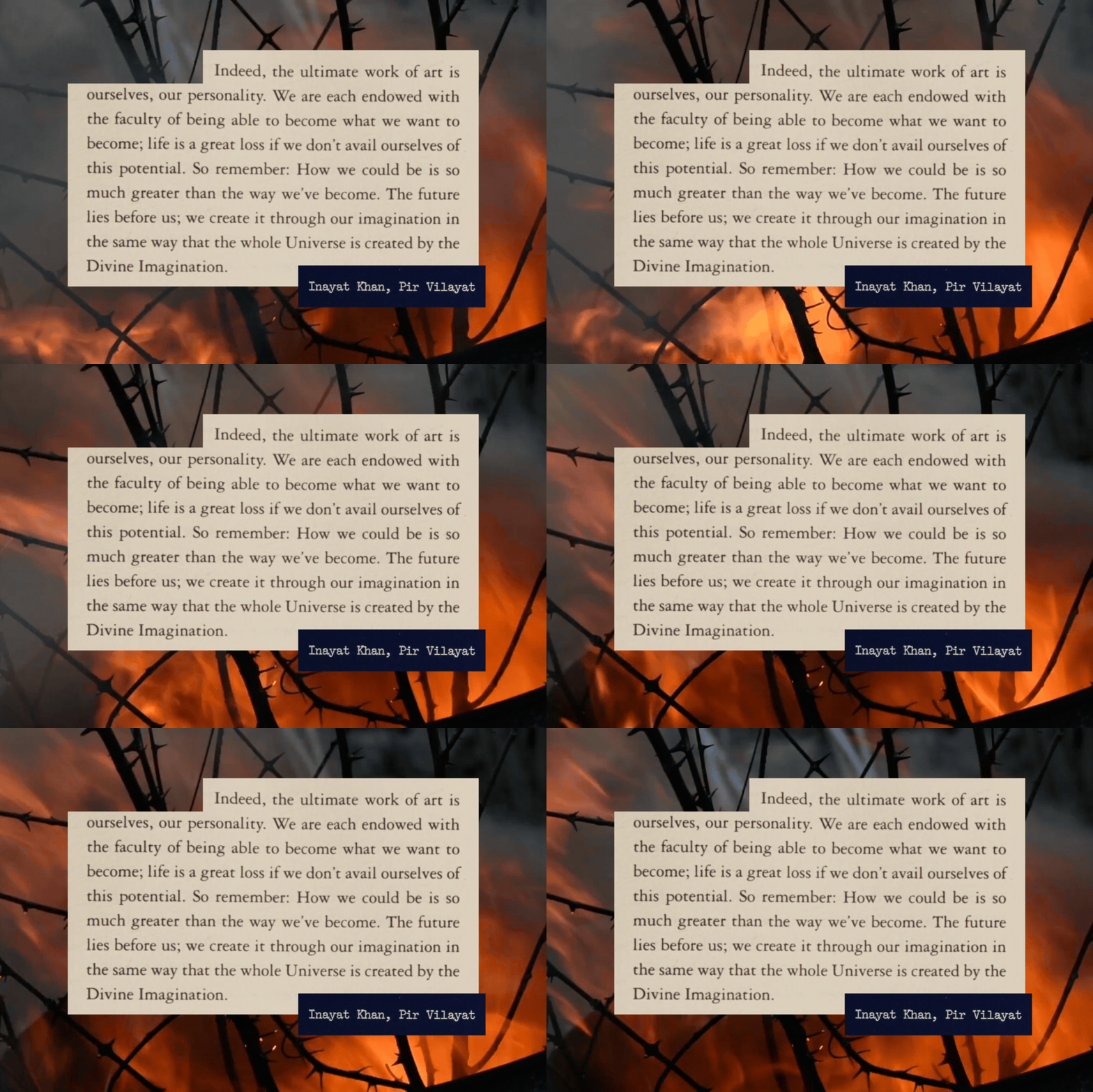
Perhaps this is the hero’s journey of ultimate redemption, resuscitating the unconscious for its repatriation. I’m reminded of Princess Mononoke, when Nago, the Boar God, endured the shot of an iron bullet whilst defending his forest from humans. The iron bullet remained lodged deep within his flesh, causing excruciating, unceasing pain which slowly poisoned his body. The festering poison eventually led to his psychological collapse, where instead of accepting his death as part of the natural cycle of life, Nago gave in to his fear of mortality and his immense hatred for humanity. His negative emotions physically corrupted him, turning a once revered God into a Demon. His overwhelming hatred manifested outwardly as a swarm of writhing, snake-like dark worms, a parasitic corruption that completely took over his entire body- transforming him into a mindless engine of destruction that sought only to spread his pain and torment to others.
In a blind, mad rampage, Nago flees his home forest and attacks a hidden village of the Emishi clan, where he encounters Ashitaka, their last prince. Ashitaka kills the demon with his bow to protect the village, and in this act, inherits the very same curse that made Nago a demon. The curse, now visible as an ominous scar on Ashitaka’s arm, writhes with pain. In consulting with the wise woman/ shaman of the village, on how to lift the curse, she confirms its fatality:
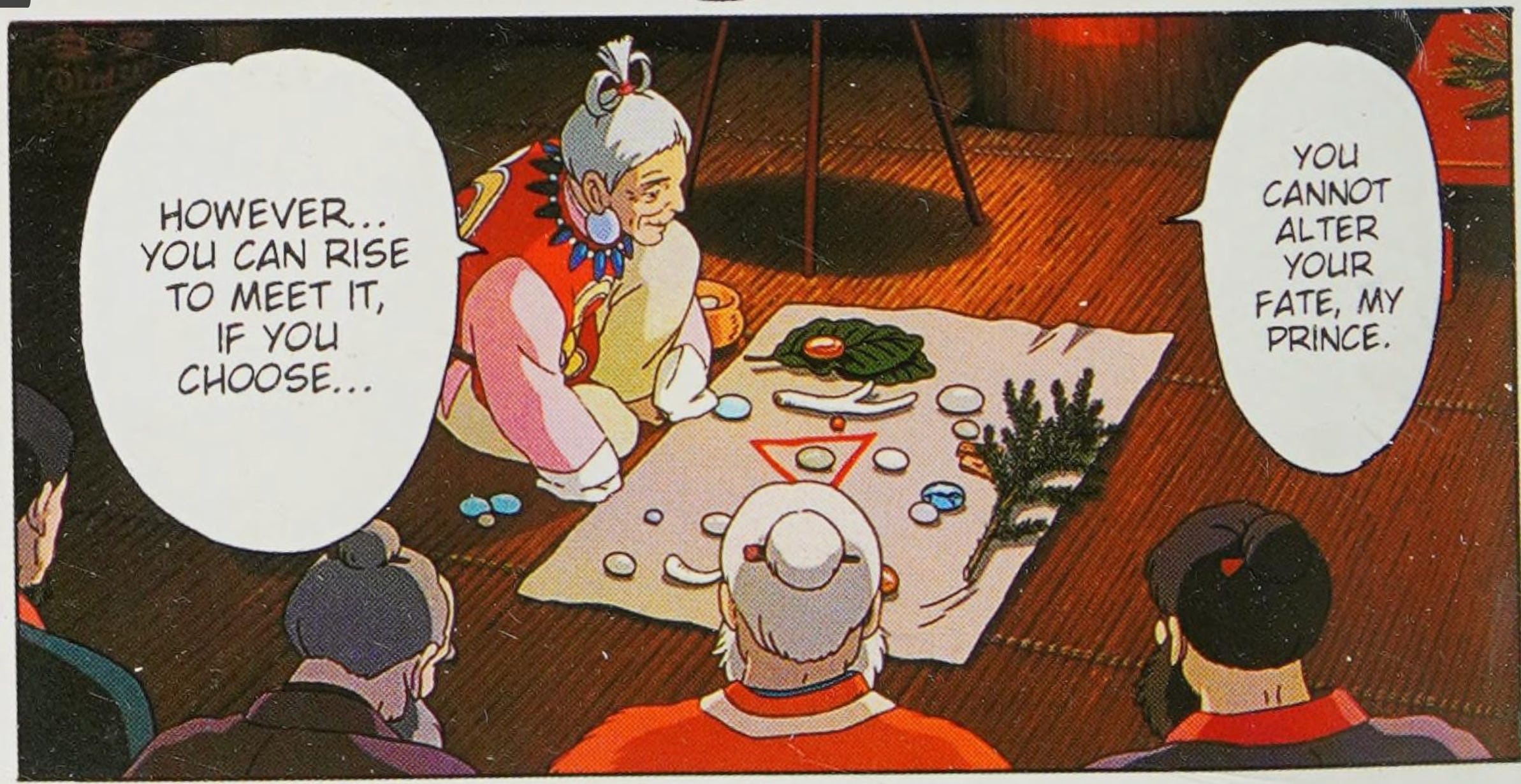
Ashitaka embarks on a journey to lift the curse. As the scar on his arm continues to spread, it grants him lethal strength and acts as a physical conduit for rage, tempting him to give in to violence and vengeance- the very same manifestation of hatred that had rotted Nago’s flesh, turning him into a demon. Though Ashitaka learns to carry the curse differently: he uses its strength without letting it use him, to keep from becoming what Nago became. (*spoiler alert*) The curse doesn’t disappear, in fact it continues to spread, right up until the end, but it doesn’t deter Ashitaka from living his truth. The curse stops acting through him unconsciously, the way it acted through Nago, and becomes something Ashitaka bears consciously instead- restrained, directed, refused the chance to repeat the violence that created it.
Ashitaka’s journey, to me, feels like a strong parable for the unconscious inheritances we may carry. Where I mistook fire for nobility, romanticising suffering as heroic, proving my sense of worth through endurance/ pain- Ashitaka refuses this false redemption; he carries the curse without letting it flatten him into a hero. His journey is a test of the infinite possibilities of the divine imagination Pir Vilayat signals toward. It speaks to the courage and strength needed to invent a future from what’s been given, without self-victimising, scapegoating others or being in denial of our inheritance. Radical accountability.
❧
There is an analogy in Hazrat Inayat Khan’s teaching with the seed and the fruit. Where the eternal aspect of one’s being is likened to the seed, and the transient, evolving personality is like the fruit. The purpose is in the fruit, not the seed- and yet the seed is no less remarkable for that, everything is contained within it. Much more went into producing the seed than shows, condensing a vast gamut of abstract principles into a single, tangible, crystallised form. The entire possibility of the plant, consolidated and held within the seed.
But a seed left alone is only potential, it becomes a fruit only through exposure- of sun, soil, and to the unique conditions of its unfolding. Our nature is the seed itself, what is born in us: the raw material, inherited, unchosen, becomes our gift or curse, depending on how we come to hold it. Character is what the exposure builds- the weather worked into the grain, the qualities we cultivate, acquire, and are shaped by, layered over the nature until the two are barely distinguishable, though the nature will still, on occasion, "burst forth when one has lost control of oneself." And personality is the fruit itself; nature and character, ripened together- "the blending... of nature and character" as an artistic practice.
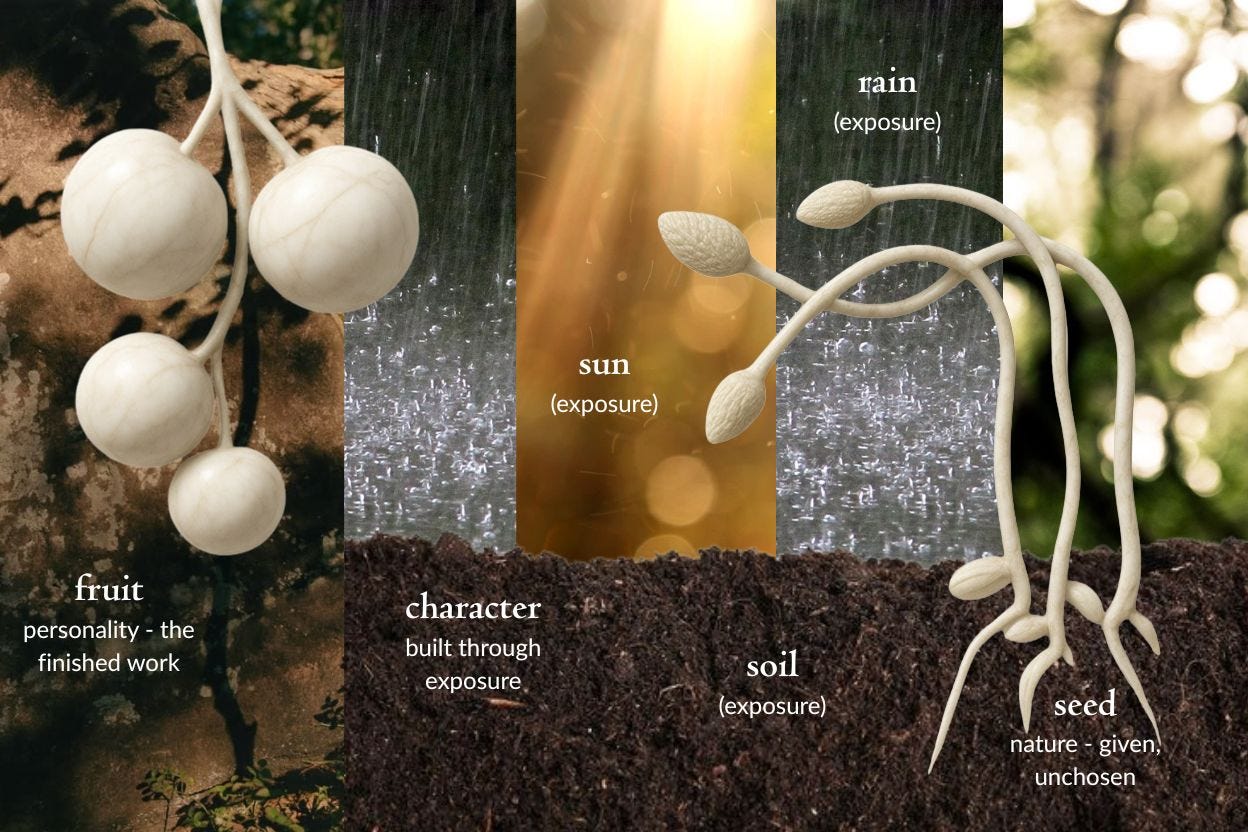
This is probably why personality is called the art of arts- not because it’s decorative by any means, but because it’s the one material we’re given no choice but to work with, and total freedom in how we shape it. We do not choose our seed. We choose, again and again, what we do with the exposure- the sun, soil and conditioning- that our particular unfolding brings us.
The Sufi dervish, Abd-ul-Jabbar Niffari, is said to have asked: “Why do you look for God up there? He is here! Here!” This is poignant to note, because so much of theological scripture points to a God far away in the heavens somewhere. What Niffari gestures toward is a God that’s here, in the seed becoming fruit in real time, in the personality still being worked on, unfinished, imperfect, and for that reason, exactly where the divine has always chosen to work.
Is it any surprise that the whole premise of any wisdom teaching or philosophy is about returning to the present? Hujwiri says, “The instant of time cuts the guilt of the past and the prefiguration of the future.” Held within the seed of every moment is a pregnant fruit, awaiting its devour. Like the ouroboros in its perpetual cycle; not the whole of the past- forgiven, not the whole of the future- secured. Just this moment, here, now. The one you’re actually reading this in. This is where the seed is ever becoming fruit.
So, how does God realise divine perfection in humanity? Pir Vilayat says that “The bounty of God’s perfection cannot manifest as reality without our conscious participation,” and it’s this very participatory nature that I can now lean into. The unconscious inheritances I carry will still keep unravelling, and there’s no rush to be resolved by them. Divine perfection was never a finished state of “wholeness,” waiting somewhere beyond in the ethers for us to catch up to. In my primitive understanding, it is what’s asked of us, in the very moments we find ourselves in, of living life; the fire we keep choosing or refusing, the parents we recognise ourselves as descendants of, the curses we may carry consciously, or may be carried by. Perfection isn’t waiting inside imperfection like a dormant seed within its shell, it's the very movement of imperfection that is perfection, unfinished, in motion, and ours to move with.
We are, each of us, still being made. And so is God.
“I am sinner, I am saint.
I am the beloved and the betrayed.
I have no joys that are not yours,
no aches which are not yours.”
— Kamala Das
I loved the clarity and expanse of this essay! So grateful to witness this unfolding!
It took me days to read the entirety of this brilliant synthesis and personal journey. It challenged me to conceive of my life and purpose in new ways. I'm still processing and will be re-reading. Thank you for this gift.