

“The duality of real being is obscured by conventional human thinking. Hence what is its absurdity to the intellectual becomes its strength to the intuitively perceptive.”
– Idries Shah
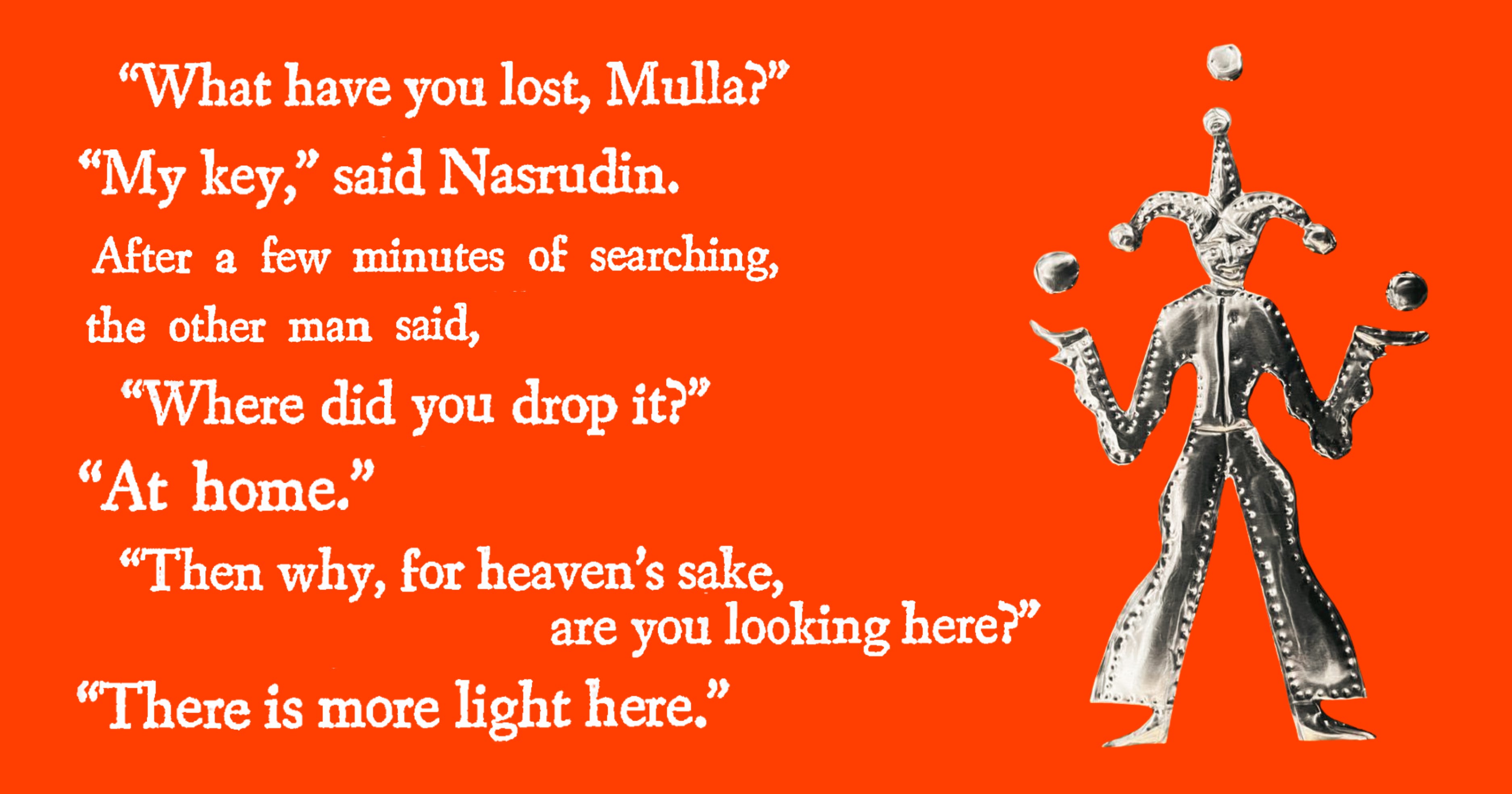
On the first read, this probably comes across as just another silly story.
On the contrary, it’s actually one of the most famous of all Mulla Nasrudin tales, used as an allegory by many Sufis through time. Filled with metaphor and symbolism, the story depicts Mulla Nasrudin, in his caricature of the Fool, succumbing to the mechanisms of rationalisation. You’ll notice this as a common thread in most Mulla Nasrudin stories, where the logics of external reasoning are used as a ploy or effective device to reveal rationalisation’s obstruction to the deepening of perception.
Without going into the semantics or mystical symbolism of the key, door, and home, (so as to leave some meaning-making for your own,) the very connotations of “light” and “dark” within this story speak to the ‘duality of real being’ that the Idries Shah quote (above) is about.
The other man asks the reasonable question of where did you drop it? He is seen as the intellect at its best, logical, helpful, inquiring into the Mulla’s search. Nasrudin’s response, on the other hand, reinforces that logic to an extreme; because indeed, there is more light outside. This, to the intellect, is absurd– Nasrudin comes across as a confused, silly man, wasting his evening. When in actuality, Nasrudin cosplays the Fool to expose the falsity of ordinary assessment. By searching for insight (one’s key to enlightenment) where it is obviously bright, seemingly comfortable, safe, familiar, “approved”, we miss the truth hidden in the shadows of the dark or the subconscious. By clinging to the light, what has been forgone in the shadows?
The “light” here, to me, represents the safe, the familiar, the well-trodden path. These are the paths carved out for us by the institutional establishments of our current civilisation. They are part of a larger system that thrives on the public’s mechanical compliance of these paths, enforcing monolithic ideologies that are legitimised through superficial metrics of credentials and status (–yes, this includes Science too). By deciding what counts as visible, credible, and worth looking at, the system socially-engineers authority and reinforces rigid ideological orthodoxy. The more the system insists on being the only “light”, the more dangerous it is in its demands of oppressive compliance– and the closer it comes to tyranny.
When the whole body of intellectual human thought is expressed in terms of external reasoning, the Fool archetype emerges as the holder of its extremity, an affect (and effect) of polarity to expose the falsity of ordinary assessment. As Idries Shah says, “Mystical experience and enlightenment cannot come through a rearrangement of familiar ideas, but through a recognition of the limitations of ordinary thinking– which serves only for mundane purposes.”
This is also the grounds for genuine critique of institutional power, where the Fool is the eternal jester; a skeptical observer of social order; active, critical, questioning all that appears self-evident. The jester is the embodiment of imagination, pluralism, individuality, playfulness; they relish the tensions between ideals, and enjoy exploring the future, the possible, the hopeful. The jester’s constant effort is to consider all the possible reasons for contradictory ideas. It is dialectical by nature, simply the attempt to change what is because it is. The jester relishes these contradictions so as to prevent the mind from settling on a new dogmatic stance, and refuses to cling to any partial concept as absolute truth.
They are motivated not by a desire to be perverse but by distrust of a “stabilised” system. In a world where everything has been carefully planned and predicted, the jester represents the force of an active imagination defined by the opposition it must overcome (–‘duality of real being.’)
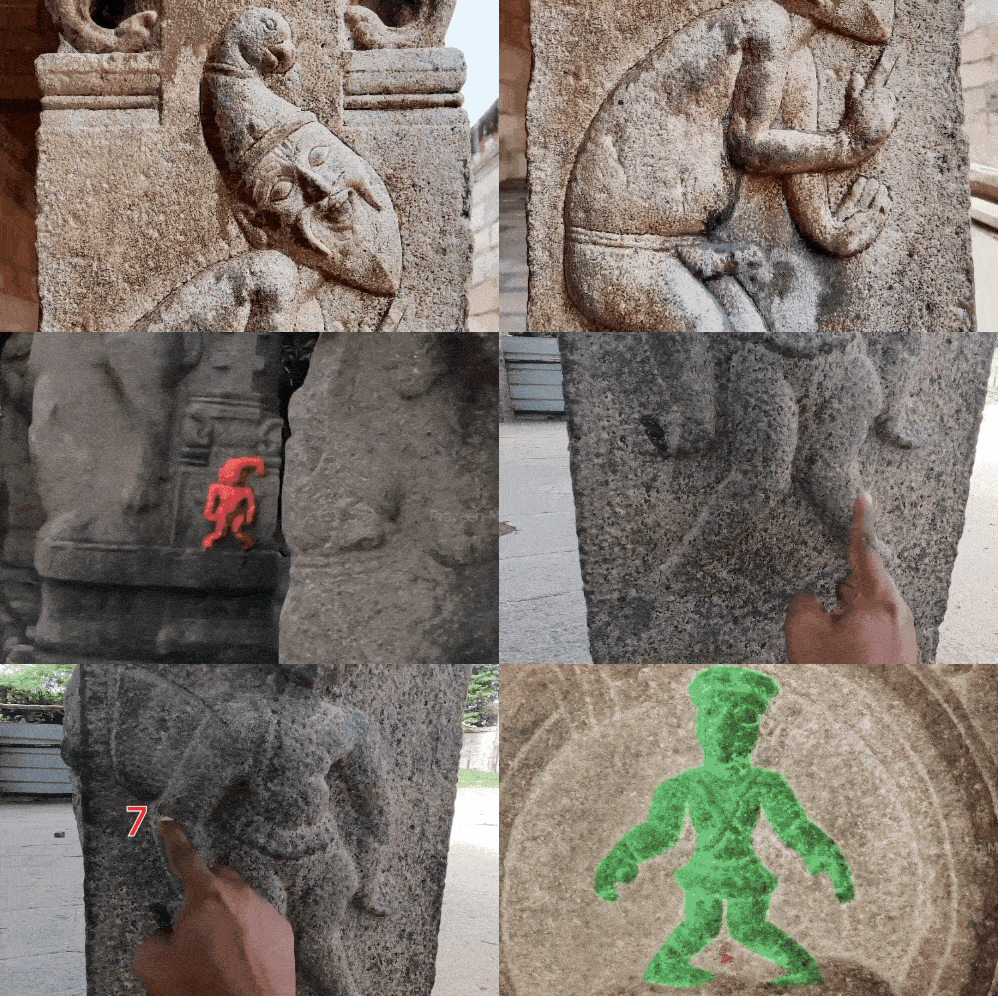
In Vedantic philosophy, an ancient sage named Aṣṭāvakra is credited with composing one of the greatest treatises on non-dualism: the Aṣṭāvakra Gītā. His very name (अष्टा Aṣṭā, meaning eight in Sanskrit, and वक्र Vakra, meaning folds, bends, or knots) is representational of his physical deformities, which become a point of ridicule in the court of King Janaka.
As the story goes, when King Janaka puts out a call for a teacher/ guru of the highest order, Aṣṭāvakra walks into the court and all the assembled scholars, the most learned minds in the kingdom, burst out laughing –out of an instinctual verdict that a deformed body cannot hold wisdom. In response, Aṣṭāvakra laughs too, in fact he laughs louder. When the King asks why, he answers that he had come to an assembly of the wise and instead only found cobblers; those who judge nothing but the outer skin. The court had cast him as the fool, and Aṣṭāvakra reclaimed the role, only to subvert it.
Here we can see parallels between the Mulla Nasrudin story, where the court represents the “light”; the brightest room in the kingdom, filled with those entitled to dictate what counts as wisdom. The key stands right before them, in the “dark” of a crooked body. And as the Idries Shah quote goes, what is absurd to the intellectual becomes strength to the intuitively perceptive; the very thing the scholars laughed at is what held the teaching.
I’d be lying if I said I didn’t totally care about what the world thought about me. For the first time last year, I held a paintbrush again after more than a decade. I always enjoyed painting and creating art as a child but as I grew older and my conditioning of what “good” or “bad” art was began to calcify, I distanced myself from it. For so long, the creative urge in me was left in the dark as a lone, lost key, waiting to be found. Thankfully I’m back in the dark room now; wary and uncertain, my self-worth oscillates between fear of scrutiny and seeking external validation from institutional markers. The key I’m looking for holds liberation, like the inner knowing and strength in Aṣṭāvakra’s laugh. What does it mean to be a liberated person?
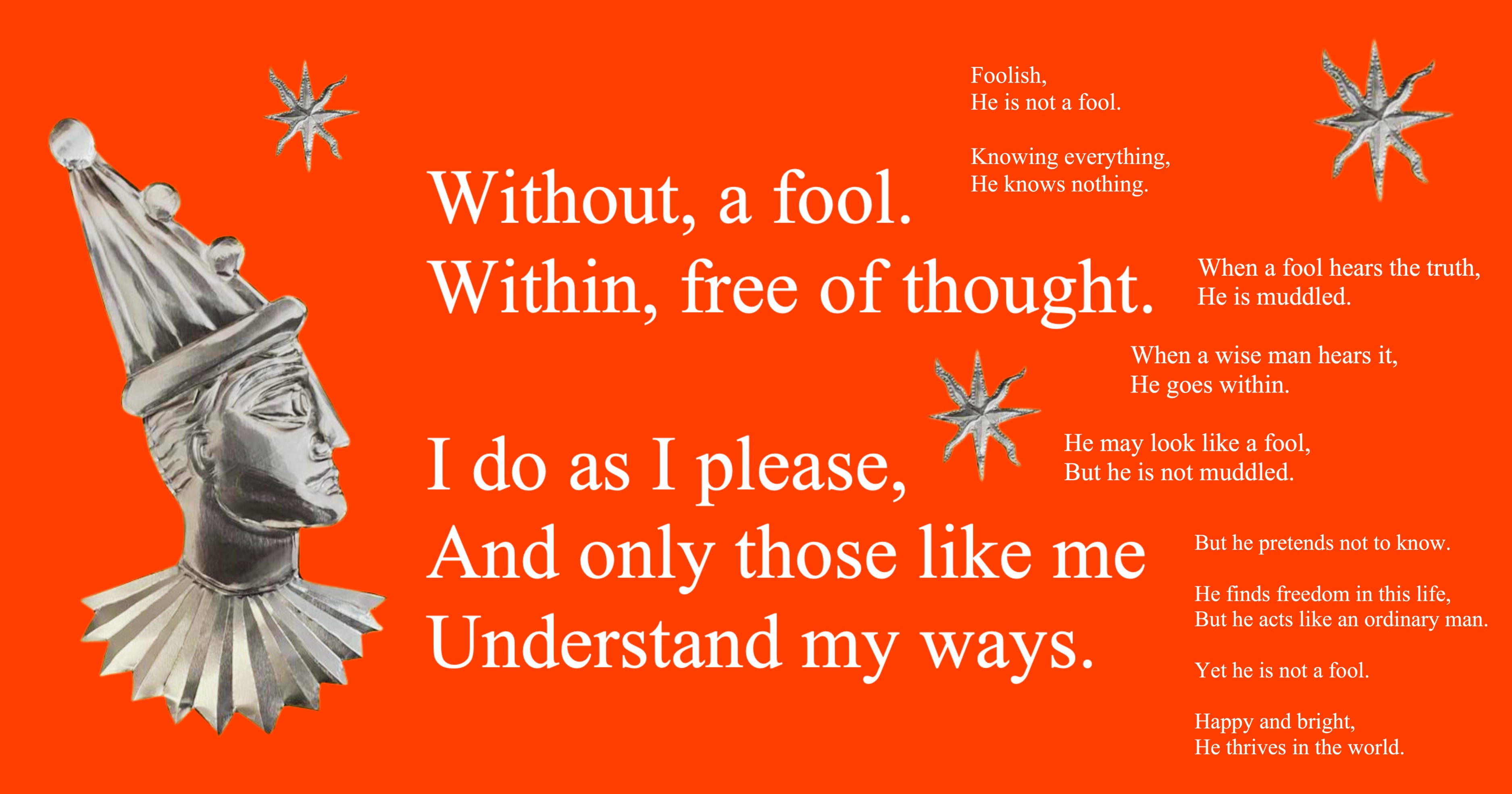
The Aṣṭāvakra Gītā describes the liberated person as one who may move through the world looking like a fool or a child, ordinary, even foolish on the outside, while inwardly free. To me, this is the jester’s freedom. A system that judges only by the surface can’t really see me, and what it can’t see, it struggles to control.
A more recent echo of this on a grander scale, was in May 2026, when India’s Chief Justice referred to the unemployed youth as “cockroaches”. What played out is reminiscent of Aṣṭāvakra’s court scene, where the youth of India reclaimed the epithet and subverted it to fuel dissent. Within days, the Cockroach Janta Party (CJP, a name that mocks the ruling BJP) had millions of followers online. In the weeks that followed, the movement went IRL to many cities across India, where tens of thousands took to the streets. Protesters showed up in all sorts of costumes and meme-like posters, and danced on the streets despite being met with unconstitutional police brutality. The joke didn’t fizzle out; after 7 weeks of protest the education minister resigned.
In a similar vein, long before the genocide in Gaza, the West Bank village of Nabi Saleh saw protesters in clown outfits, masks and superhero costumes. Villagers protested every week against the settler takeover of their spring, marching toward a line of soldiers waiting to stop them. Here’s a powerful video that remains etched in my heart, that leaves me teary-eyed whenever I revisit it. A clown and his red nose, standing amongst fully armed “IDF” troops– bringing to light the absurdity of separation between people.
Then there’s Pepe the frog. Beginning as a laid-back character in Matt Furie’s comics, Pepe lived several lives before taking on the mask of the Fool. In the US, Pepe was adopted by Trump supporters and the alt-right during Trump’s 2016 presidential campaign, which led to the Anti-Defamation League labelling Pepe a hate symbol. In Hong Kong, young people were already sending him to each other as playful stickers when huge rallies broke out in 2019, and in more than a hundred days of protest Pepe became a symbol of a pro-democracy resistance against an increasingly oppressive government and state. Pepe banners and stuffed toys became ubiquitous, offering levity as the violence escalated. The protesters knew his history in the West and debated it online, with the consensus that Hong Kong’s Pepe was a distinctly local meme. As one of them put it, “he is what we make it.”
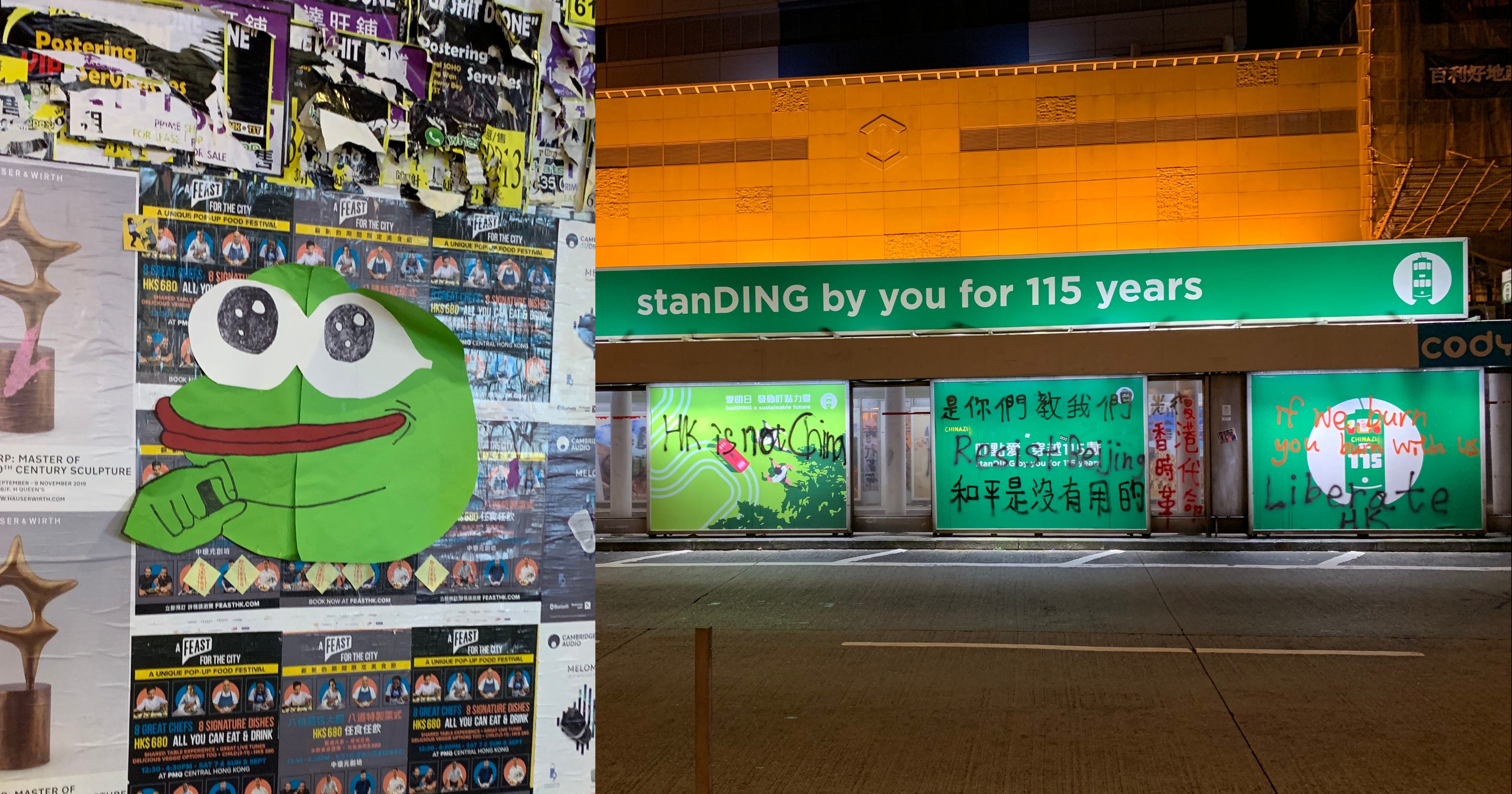
This is true of all things, the meaning we attribute to them is what they become. Through the architectures within our subconscious, forms assume meaning, and so the mask of the Fool may be worn by a troll in disguise.
Pepe was once the face of the far right in America, adopted by supporters of a presidential candidate whose comedic nature we’ve all been susceptible to; Donald Trump, perhaps the most mocked and mocking political figure of our present time. Trump is the epitome of a memetic trope, a person who ‘jests’ from a place of institutional leverage, risks nothing –atleast nothing for themselves, while their subjects remain powerless at their hands. These are the ingredients of the troll, realised in the highest decrees of statecraft, while leaving the public to bear the cost of the troll’s jokes. The jester, on the other hand, is the one risking it all– where freedom becomes exposure to structural power. The troll already has licence, unscathed and seemingly invincible, powered by outdated stabilised systems.
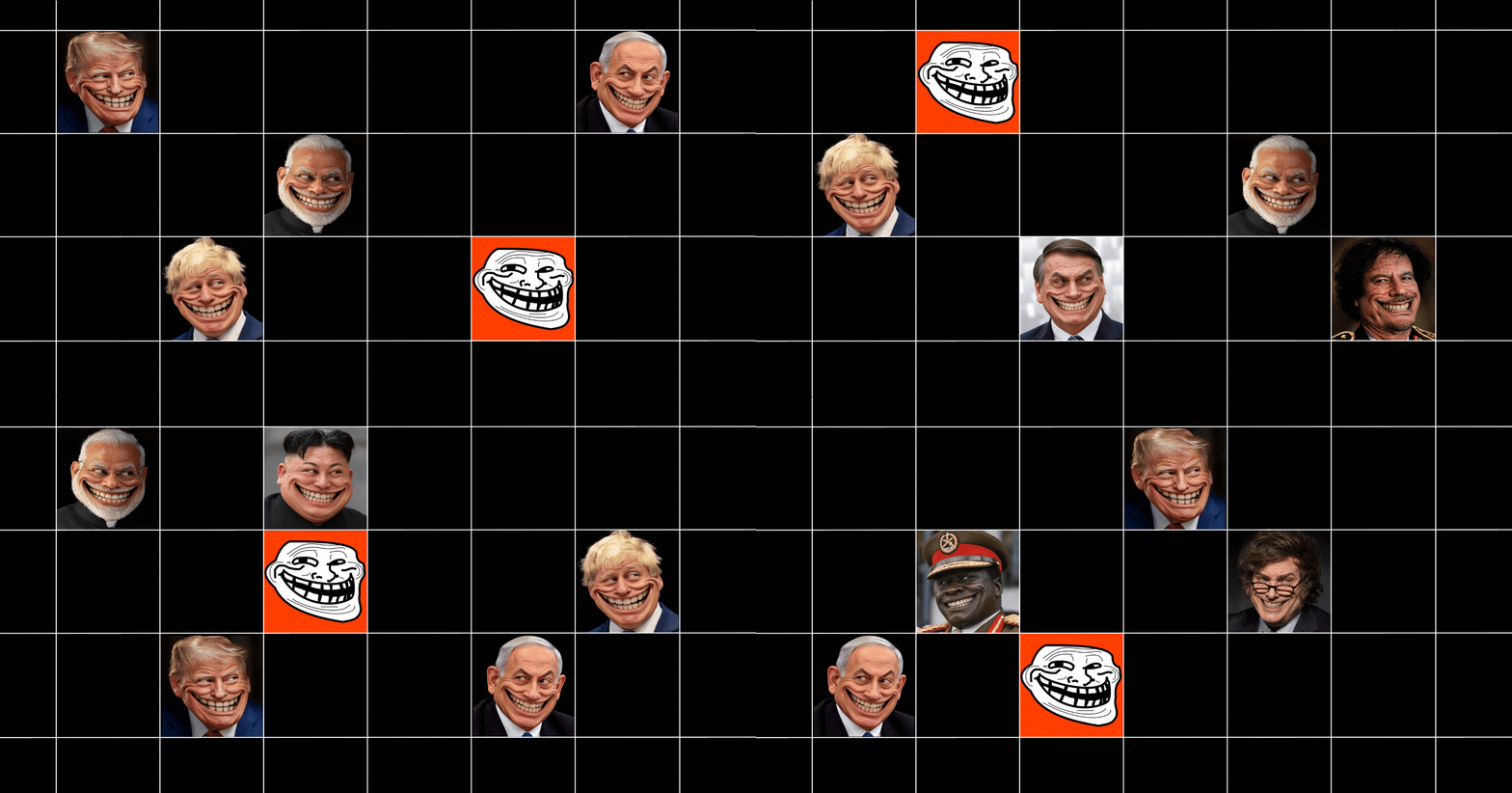
In fact, as the troll is enabled by the system, so is the system enabled by the troll; the troll’s clinging to a particular paradigm reinforces its ideology and moral dogma, curdling into a fundamentalism so sour that everything outside its known periphery is deemed a hoax. The jester holds their stance lightly, with a deeper knowing that all truth is relative and thus limited; every stance becomes a partial handle into reality. As Ram Dass famously said, “all reality is relative.”
The litmus test of the geopolitics of our time are the trolls that have led (and continue to) some of the most powerful nation-states; from Boris Johnson to Bolsonaro, the list continues to grow.
In order to keep the system ossified, an age-old strategy is to exile the jester or control their message. By demanding that the jester speak strictly within its predefined categories of “approved truth,” the system uses legal coercion and explicit threats of punishment to enforce compliance. This is evident in India, where the excessive censorship on free-speech and state-controlled media has led to comedians stepping in as satirical truth-tellers. So much so, that criminal defamation has become a tool for the government to muzzle certain comedians, aimed at neutralising their disruptive impact.
When an institution cannot suppress the jester's truth, it attempts to co-opt and standardise it. Sometimes the jester’s truth is so radical, that it becomes manipulated by institutional media and broadcast as mere satirical comedy, thus establishing its absurdity as the baseline of a consensus truth on reality. The jester’s exposure to structural power thus risks sanitisation of their message, pathologisation of character and domestication of thought. Is it any wonder why the jester feels like shit when they’re systemically and consistently being gate-kept from opportunities, platforms and social capital? We can also see this in how celebrities who have been actively vocal about the genocide in Gaza (shoutout Javier Bardem, Susan Sarandon, and more recently Macklemore,) are at the receiving end of this gatekeeping. Institutional gatekeepers demand allegiance to their ideologies and reward compliance with system dominance.
Ok, I’ve said a lot about the “system” up till now, so let’s define it. (My “writer-brain” is telling me to edit this definition to earlier in the essay, but you know what? We’re jester-ing here 🤡). The system is made up of all institutional establishments; they are the royal courts, the academic bureaucracies, the religious hierarchies, the political administrations, the scientific hegemonies, the arts foundations, etc etc. They are the entities that script identity roles of individuals, prescribing them to perform system-compliant behaviours rather than thinking critically or challenging institutional structure. They exile the jester, labelling them the outcast, the weirdo, the abnormal, or (and my favourite, which I continue to receive from a derogatory uncle) “touched in the head.”
In fact, the system encourages people to turn their personal suffering and trauma into professional currency, redirecting potential political or structural agitation into institutional self-objectification and peer-policing; aka “woke-ism.”
Cultural theorist and my fave professor du jour, Catherine Liu, says wokeness and identity politics mark a departure from traditional left-wing concerns such as wage labour, economic inequality, healthcare, and working-class emancipation. Instead, liberalism has hardened into an ideology focused almost exclusively on cultural representation, affect, and personal identity. When personal narratives consume political situations, they create “theaters of empathy” and afford individuals an “immunity against critique,” insulating public figures or intellectuals from genuine political scrutiny. Despite presenting itself as progressive, this ideology is characterised as hyper-individualistic and anti-social, undermining true class or community solidarity.
Catherine also points out that adding new identity categories merely legitimises and strengthens existing institutional power structures, rather than transforming or dismantling them. She critiques practices such as "raising awareness" and critical race theory as superficial substitutes for political agitation, economic transformation, and actual political education.
Wokeness functions as an institution of moral performance where individuals feel compelled to constantly prove their moral purity by signalling alignment or risk collective indignation. Moral performance that costs the performer nothing is the troll’s move, no matter who stages it. The jester is the counter-weight, acting as the subversive antidote that dismantles such orthodoxy.
But orthodoxy is patient, and where it cannot silence the jester, it learns to imitate them. There’s a Mulla Nasrudin tale around this kind of imitation. A relative once brought Mulla Nasrudin a duck as a gift, and Nasrudin, delighted, had it cooked and shared the meal with him. Word travelled, as word does, and soon strangers were showing up at Nasrudin’s door, each one further down a chain of acquaintance; the friend of the friend of the man who’d brought the duck, and each expecting to be fed. Nasrudin humoured them for a while. Then, his latest guest and the most distant claimant arrived, rationalising the scanty connection. To him, Nasrudin served a bowl of hot water; the soup of the soup of the soup of the duck.

This is what “apolitical art” so often is; a reduction and sanitisation of its inherent message, stripped away of its transformative power so as to make it easily digestible by the system around it. I don’t believe that art without politics can be such a thing, but when the inherent message that sparked its creativity is watered down so far from its original source, only the memory of its flavour remains.
“Any narrative given to the world in a digestible format necessarily involves some degree of fiction.”
– Bianca Censori
The system’s power rests on a single, unspoken claim: that its truth is the only truth. Political regimes govern through “relative truth;” man-made laws designed to compel obedience.
When a royal guard once threatened to hang Nasrudin unless he told the truth about where he was going, Nasrudin answered, “I am going to be hanged on those gallows.” If the guard hanged him, he had spoken truly– if the guard let him go, Nasrudin had lied; revealing the crack in the state’s own logic. The jester doesn’t confront tyranny by arguing against its decrees, instead through paradoxical encounters, the jester forces authority to confront the arbitrary nature of its own decrees until they become impossible to dismiss.
This is the deeper current underneath all the satire; the Modi memes, Trump jokes, costumes at protests and clowning at checkpoints, are themselves the exposure to the limitations of a singular claimed truth, without the assertion of another. The jester’s jig enables the possibility of another reality, creating an opening for imagination, beyond the scope of its predecessor.
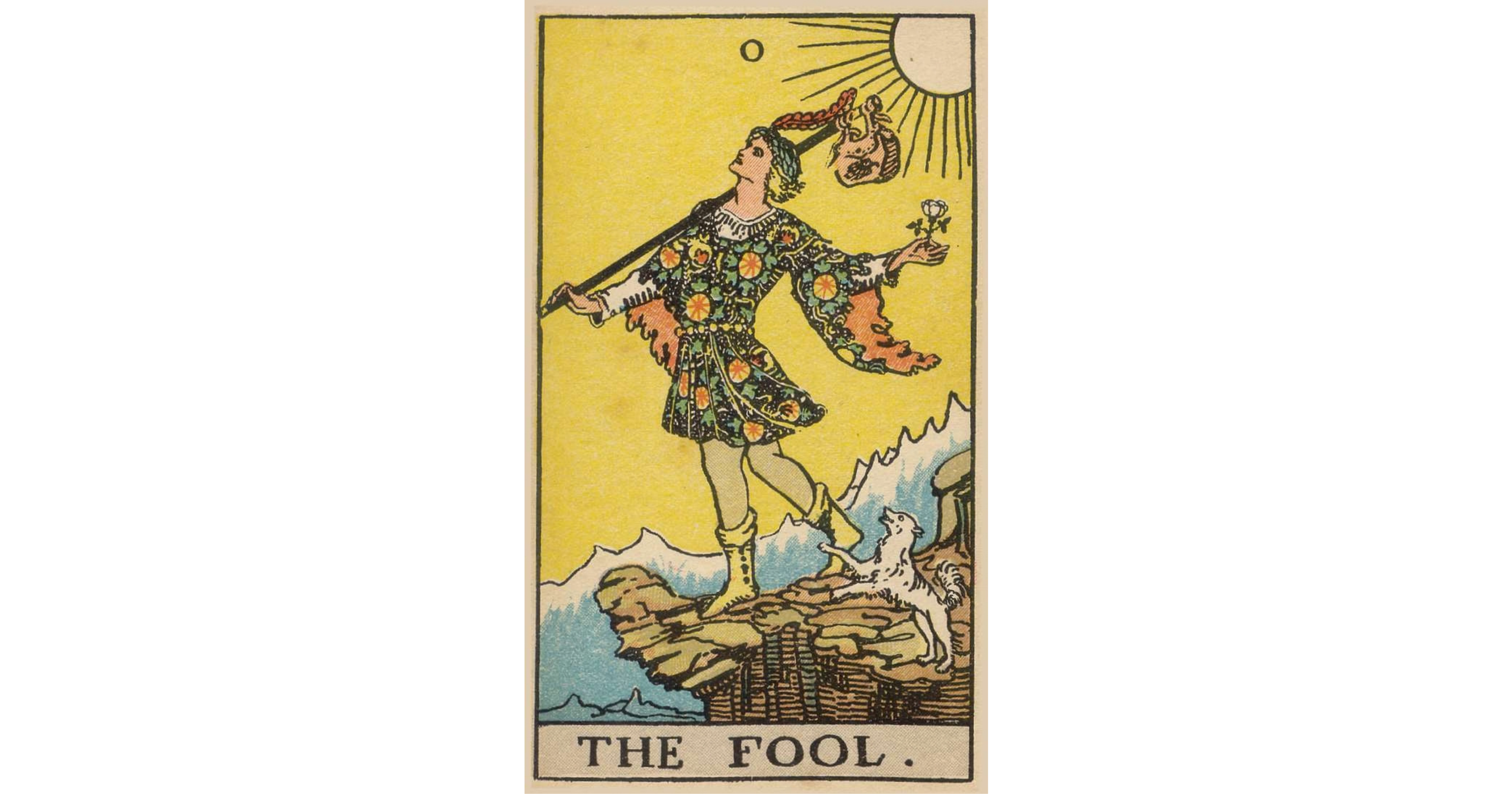
This essay wouldn’t be complete if I didn’t mention the Fool from the Tarot. The Fool card carries the number 0 because it isn’t tied to any specific identity, truth, or reality. And yet, stitched into his cap, he already wears the wreath, the symbol of victory and completion. This is the same wreath that crowns the World card– the final card in the Tarot deck. The Fool has obviously not earned it through the journey, instead it’s carried before the journey has even begun– this is worth sitting with. What has earned the Fool their wreath?
It's because the Fool has no self-image to defend that they remain free from judgement –resting, already, in their own completeness, and without needing to prove anything to anyone. This is also why they can walk toward the cliff's edge without flinching; sure it could seem reckless, but there’s a deeper wisdom and recognition that the fall isn’t worth organising life around. The Fool sees that buying into a singular reality merely creates a self-imposed box that can suffocate or stunt one’s potential (–ever witnessed a mime in action?). And so by standing outside the numbered order as 0, the Fool demonstrates that multiple realities can coexist. Each reality is true only within its given limits, so to awaken from any single reality is to recognise its relative nature.
This is how the Fool’s archetype subverts tyranny; by exposing its underlying absurdity, shattering its legalistic pretension, and pointing to an unconditioned reality beyond state power.
Think of the joker within a pack of cards, it stands apart from the rest of the suits and their monarchies. The joker disrupts the game, reorienting its existing patterns to allow the unthinkable, the unpredictable, and the “wild” into play.
The Fool confronts and disarms the system and its tyrannical modus operandi by refusing to recognise or validate its rules of engagement altogether. The Fool’s resilience is their unselfconsciousness, by refusing to buy into identity politics and its image-crafting, the Fool gleefully casts off the fear of ‘trying, dying, and looking stupid.’ By exercising humour as a metaphysical leverage, the Fool exposes how “serious” cultural anxieties and image-crafting are mere superficial games. The Fool’s laughter becomes their power, especially when failing to meet worldly standards. In recognising that the dramatisation of state-sponsored media, tyrannical hierarchies and worldly power are merely fleeting appearances, the Fool dismantles the system’s outer paraphernalia and refuses to compete for power within its hierarchy.
Perhaps this is what I was reaching for when picking up the paintbrush again. I wasn’t looking for a better verdict on my artistic capabilities– the wreath, it turns out, was already in my hand in the form of the paintbrush. Through my seeking, I had found something I had forgone in the shadows of what I believed to be too wild and unruly to fit within the standards of the system.
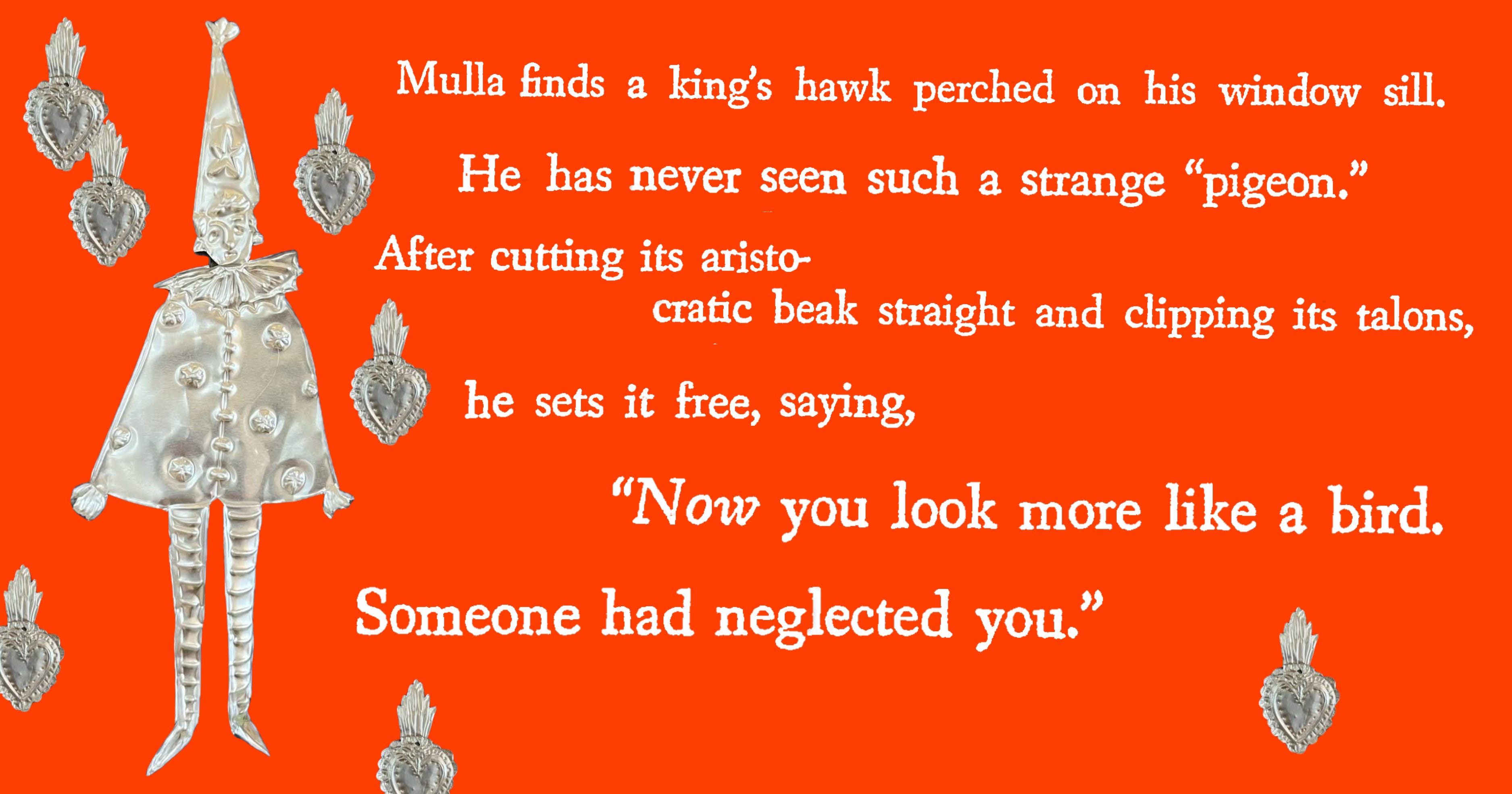
And maybe the real insight (from the first Mulla Nasrudin story) was never about retrieving the key at all. What if the door was never locked? And home was the dark room we refused to enter?
To go looking in the dark– to actually go, and not just gesture at it from the safety of the light outside– is the only practice the jester really offers. A radical way of being in the world.
Are you ready to step into your jester?
Thank you so much for this, one of the most beautifully written pieces I’ve ever come across. I’m overjoyed!